
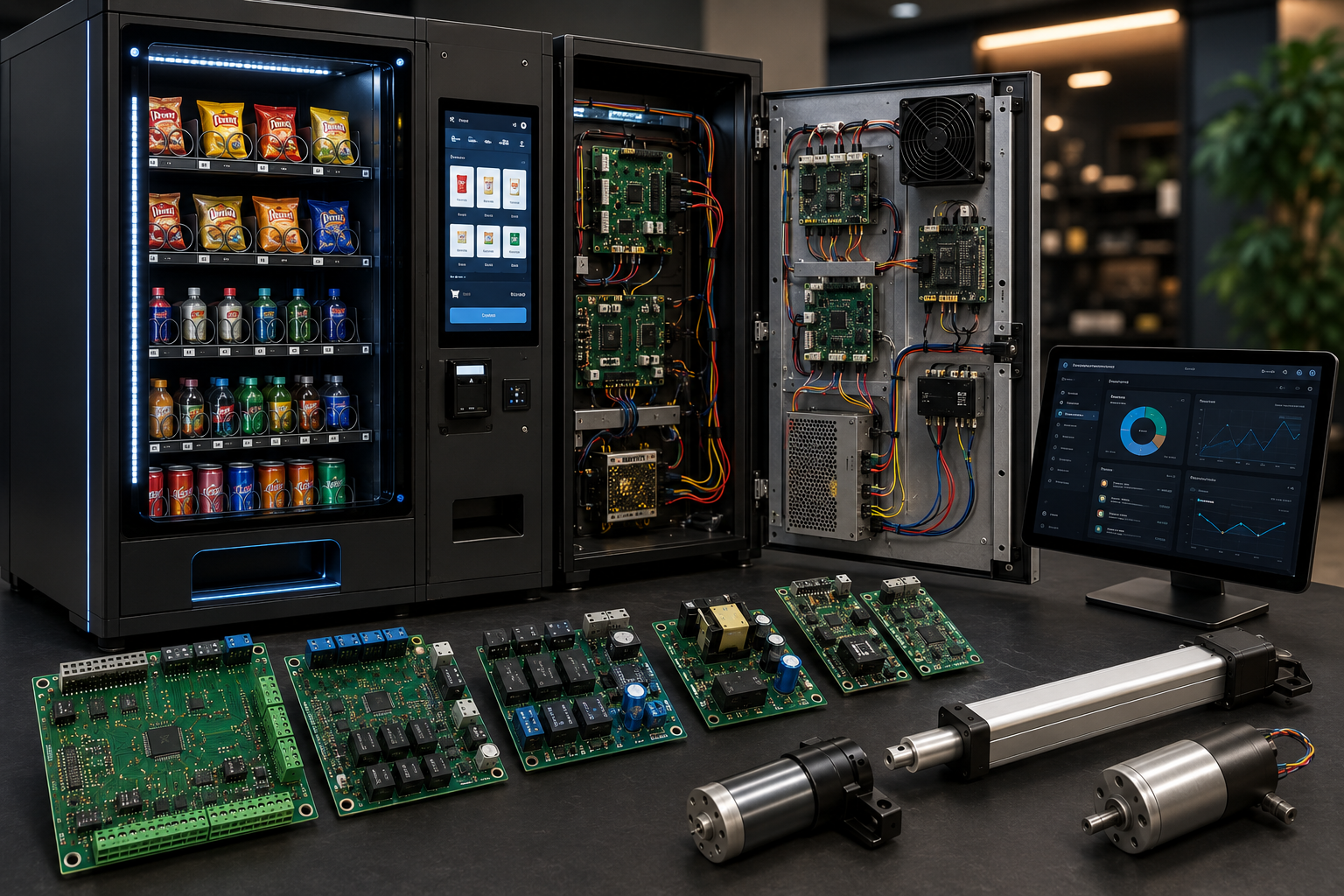
Vending Machine Embedded Control
A distributed embedded control platform featuring a central controller, dedicated motor and refrigeration boards, cloud connectivity, touchscreen operation, and real-time management for commercial vending machines.
Project Overview
The Smart Vending Machine Embedded Control Platform was developed as a complete electronic architecture for next-generation commercial vending machines.
Instead of relying on a single controller, the system is built around multiple custom PCBs working together through a distributed embedded architecture. A central controller communicates with dedicated subsystem boards responsible for motor control, refrigeration management, power distribution, and machine monitoring.
The entire platform communicates with an industrial PC through UART communication while maintaining Wi-Fi connectivity for cloud synchronization and remote management. This architecture provides excellent scalability, reliability, and simplifies future upgrades and maintenance.
Client Requirements
The client required a scalable vending machine control platform capable of:
- Managing up to 100 dispensing motors.
- Controlling the refrigeration system.
- Providing centralized machine management.
- Supporting a touchscreen user interface.
- Synchronizing with a cloud dashboard.
- Monitoring machine health in real time.
- Managing product inventory.
- Logging transactions.
- Supporting remote diagnostics.
- Providing modular hardware architecture.
- Allowing future hardware expansion.
- Operating continuously in commercial environments.
Our Solution
Metanoia designed and developed a complete distributed embedded platform consisting of multiple custom electronic boards working together as a unified control system.
The platform includes:
- Main Control PCB.
- Motor Driver PCB.
- Refrigeration Control PCB.
- Power Distribution PCB.
- Embedded Firmware.
- UART Communication Network.
- Wi-Fi Connectivity.
- Cloud Dashboard Integration.
- Touchscreen HMI.
- Production-ready PCB Design.
- Functional Testing.
Each subsystem performs a dedicated function while the Main Controller coordinates the entire vending machine through reliable serial communication.
System Architecture
Main Control Board
The Main Control Board acts as the brain of the machine.
It manages:
- Machine logic.
- Communication with the industrial PC.
- Communication with all embedded boards.
- User commands.
- Inventory management.
- Diagnostics.
- Cloud synchronization.
Motor Control Board
A dedicated control board operates up to 100 DC motors responsible for product dispensing.
Features include:
- Individual motor addressing.
- Accurate dispensing control.
- Motor fault detection.
- Stall monitoring.
- High-current driver outputs.
Refrigeration Control Board
A dedicated PCB controls the cooling system by managing:
- Compressor operation.
- Cooling fans.
- Temperature monitoring.
- Protection logic.
- Energy optimization.
This allows stable cooling performance while protecting refrigeration components.
Power Management Board
A dedicated board distributes power throughout the machine while protecting sensitive electronics and high-current loads.
Functions include:
- Voltage regulation.
- Power distribution.
- Load protection.
- Fuse monitoring.
- System isolation.
UART Communication Network
All electronic boards communicate through a reliable UART communication bus.
The Main Controller continuously exchanges commands and status information with every subsystem to ensure synchronized machine operation.
Industrial PC Integration
The embedded platform communicates directly with the industrial computer which provides:
- Touchscreen interface.
- Product database.
- User authentication.
- Sales management.
- Machine configuration.
- Cloud synchronization.
Cloud Dashboard
The machine remains connected through Wi-Fi, allowing remote monitoring of:
- Inventory.
- Sales.
- Machine status.
- System health.
- Temperature.
- Communication status.
- Maintenance alerts.
- Firmware information.
Main Features
Distributed Embedded Architecture
Multiple custom PCBs divide machine functions into dedicated subsystems for improved reliability and scalability.
Intelligent Motor Control
Supports up to 100 dispensing motors with accurate product delivery and continuous fault monitoring.
Smart Refrigeration Control
Automatically manages cooling performance while maintaining energy efficiency.
Real-Time Communication
Reliable UART communication synchronizes all control boards with the Main Controller.
Cloud Connectivity
Machine data is synchronized over Wi-Fi for centralized monitoring and management.
Touchscreen Operation
An intuitive graphical interface simplifies product selection, administration, and maintenance.
Remote Monitoring
Operators can monitor:
- Machine health.
- Product availability.
- Refrigeration status.
- Communication status.
- Sales activity.
- Alerts.
- Diagnostics.
Engineering Challenges
Multi-Board Synchronization
One of the main challenges was ensuring reliable communication between several embedded control boards operating simultaneously.
High Motor Count
Managing up to 100 motors required efficient addressing, communication, and fault handling while maintaining fast response times.
Refrigeration Integration
Cooling control had to operate independently while remaining fully synchronized with the vending machine controller.
Reliable Communication
UART communication was optimized to provide stable operation between the embedded controllers and the industrial PC.
Commercial Reliability
The complete system was designed for continuous daily operation with simplified maintenance and future hardware expansion.
Development Process
1. System Architecture
The machine was divided into multiple functional electronic subsystems to improve modularity and maintainability.
2. Electronic Hardware Design
Custom PCBs were designed for:
- Main Controller.
- Motor Controller.
- Refrigeration Controller.
- Power Distribution.
3. PCB Design
Each PCB was optimized for reliability, manufacturability, thermal performance, and electrical protection.
4. Embedded Firmware Development
Firmware was developed to manage:
- Machine logic.
- UART communication.
- Motor control.
- Cooling control.
- Diagnostics.
- Safety monitoring.
- Cloud communication.
5. PC Software Development
A desktop application was developed to provide:
- Touchscreen interface.
- Product management.
- User authentication.
- Machine monitoring.
- Communication with embedded controllers.
6. Cloud Dashboard
A cloud dashboard was integrated to provide centralized monitoring, inventory tracking, and remote management.
7. Testing & Validation
The complete platform underwent extensive functional, communication, endurance, and subsystem integration testing before deployment.